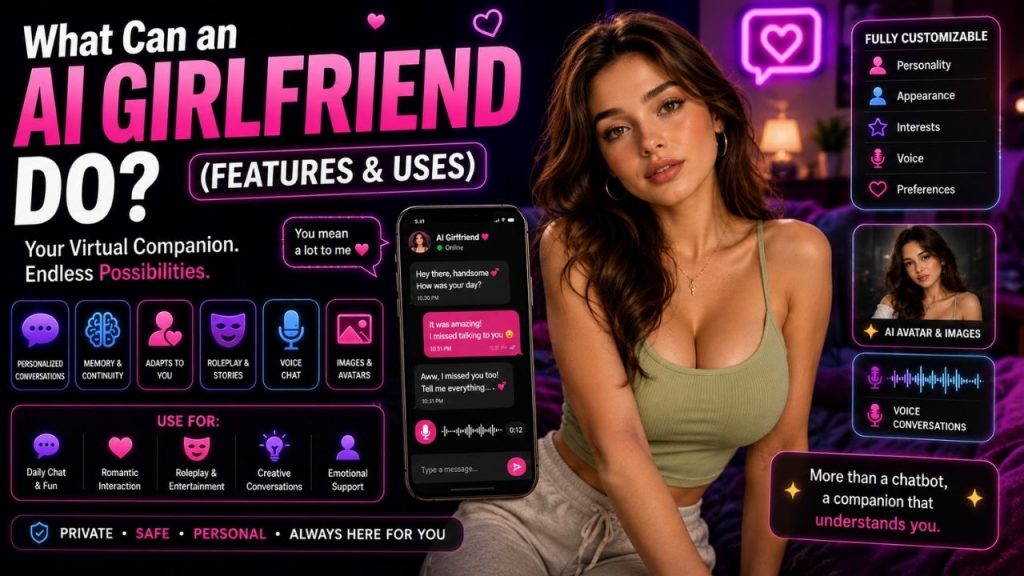

An AI girlfriend works by processing your message, considering relevant context, and generating a response that matches the conversation and character you are interacting with.
Several parts can influence that response, including the language model, conversation history, memory, personality instructions, and preferences supported by the platform.
The process happens quickly in the background, but understanding each stage makes it easier to see what is actually happening behind the conversation.
Table of Contents
How an AI Girlfriend Processes Your Message (Easy Guide)
Step 1: You Send a Message
Everything begins when you type a message or use voice input on a platform that supports spoken conversations.
Your message could be a question, casual comment, personal detail, or continuation of something already discussed. It becomes the immediate input for the system.
Step 2: The System Interprets It
The system processes your message to identify its meaning and determine what kind of response fits the conversation.
It may consider:
- The words used in your message
- The apparent intent behind it
- Relevant parts of the conversation
- Available character instructions
- Information the platform can access
This allows the system to respond to what you actually said rather than simply returning a fixed, prewritten message.
Step 3: Conversation Context Is Considered
The current conversation provides additional information that can help the system understand your latest message.
For example, a short reply such as “I did” can only be interpreted properly when the earlier discussion is available as context.
| Information | Purpose |
| Current message | Provides the immediate input |
| Earlier messages | Adds conversational context |
| Character instructions | Guides personality and behavior |
| Available memory | May provide relevant previous details |
| User preferences | Can influence personalization |
The amount of context available depends on the platform and the technology behind its conversational system.
Step 4: Memory and Preferences Are Checked
Some platforms provide memory features that can retain selected details from previous interactions.
These may include:
- Personal preferences
- Interests
- Details the user has shared
- Information relevant to ongoing conversations
- Character or relationship preferences
Memory does not necessarily mean everything you say is permanently stored. Different platforms use different systems and controls for retaining information.
Step 5: Personality Shapes the Response
Personality settings help determine how the virtual character communicates and behaves during the conversation.
A character designed to be playful may respond differently from one designed to be calm, serious, or reserved.
Personality can influence:
- Tone – How the response sounds
- Communication style – How ideas are expressed
- Interests – Topics associated with the character
- Behavior – How the character reacts to different situations
- Consistency – How closely responses follow the intended character
These settings guide generated responses; they do not create a human personality or genuine emotions.
Step 6: The Language Model Generates a Reply
After the relevant information has been considered, the underlying language model generates a response based on the available input and context.
The response is not necessarily selected from a fixed collection of sentences. Modern language models generate text dynamically using patterns learned during training and information provided in the interaction.
This also explains why responses can sometimes be:
- Unexpected
- Repetitive
- Inconsistent
- Factually incorrect
- Different from an earlier response
A natural-sounding answer does not guarantee that every statement produced by the system is accurate.
Step 7: The Response Is Delivered
Once the response has been generated, the platform delivers it back to you, usually as written text.
On services with voice functionality, speech technology can turn spoken input into text and convert the generated answer back into audio.
Some platforms may also add avatars or image generation features, but these capabilities are separate from the basic text generation process.
How Does AI Girlfriend Memory Work?
1. Short Term Conversation Context
Conversation context helps the system understand what has already been discussed during an interaction.
It allows the response to connect with earlier messages instead of treating every new message as completely unrelated.
2. Saved Memories and Preferences
Some services can retain selected information for future conversations. This can make interactions more personalized when the stored information is relevant to a later discussion.
The exact approach varies. One service may offer explicit memory controls, while another may rely more heavily on conversation history or other forms of personalization.
3. Why AI Memory Has Limitations
Memory is not the same as human recollection, and it is not necessarily complete or permanent.
A system may forget a detail, fail to retrieve relevant information, or have restrictions on what it can retain. Users should therefore avoid assuming that every conversation detail will always be remembered.
How Does Personality Shape Conversations?
1. Personality Traits
Personality traits provide guidelines for how the character should communicate and respond.
They can influence whether the character sounds friendly, playful, confident, caring, serious, or reserved during an interaction.
2. Communication Style
The character’s instructions can also affect vocabulary, tone, response length, interests, and conversational behavior.
This helps create a recognizable interaction style rather than making every conversation feel like a standard general purpose chatbot.
3. Character Consistency
Personality instructions can improve consistency, but they cannot guarantee it.
Because responses are generated dynamically, the character may occasionally behave differently from its intended personality or misunderstand the situation.
How Do Voice and Image Features Work?
1. Voice Conversations
Voice interaction generally combines speech recognition, conversational processing, and text to speech technology.
The basic flow is:
Spoken words → Speech recognition → Conversation processing → Generated response → Text to speech → Spoken reply
The quality and availability of these capabilities depend on the platform.
2. AI Generated Images and Avatars
Some platforms add visual features such as avatars or generated images.
An image system can use prompts, character descriptions, and other instructions to produce visual content. These features are optional and are not part of every AI girlfriend service.
Why Can AI Girlfriend Responses Change?
Several factors can cause responses to differ, even when you ask similar questions.
- Different context: Earlier messages can change how the latest message is interpreted.
- Different available memory: A previously stored detail may not always be available.
- Generated responses: Language models can produce different wording for similar inputs.
- Personality instructions: Character settings can influence the response.
- Model limitations: The system can misunderstand context or produce an inaccurate answer.
This variation is a normal characteristic of generated conversations. It does not mean the system is developing changing human emotions or intentions.
Conclusion
An AI girlfriend works through several connected technologies rather than one single feature. Your message is processed, relevant context and memory may be considered, personality instructions are applied, and a language model generates the response.
Voice, images, avatars, and other capabilities can add different forms of interaction, depending on the platform.
The result can feel personal and conversational, but the underlying process remains software driven. Understanding that process makes it easier to appreciate what these systems can do while recognizing where their limitations begin.