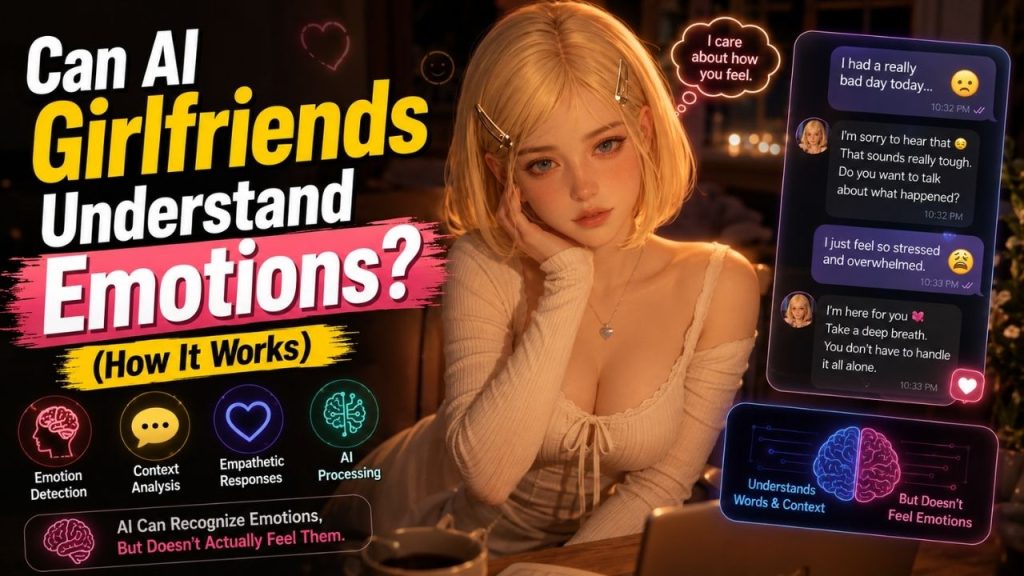
An AI girlfriend can recognize certain emotional signals in a conversation and respond in a way that sounds supportive, excited, concerned, or sympathetic. But there is an important difference between recognizing an emotion and actually feeling it.
When you tell an AI, “I had a really bad day,” it can analyze the words, the surrounding conversation, and other available context to produce a response that fits the situation. It is not experiencing sadness or concern itself.
That distinction is important when using AI companion apps. The technology can make conversations feel personal, but its emotional responses are generated by an AI system rather than coming from human feelings.
Table of Contents
Can AI Girlfriends Really Understand Emotions?
The answer depends on what we mean by “understand.”
An AI girlfriend can often:
- Recognize emotional words and phrases
- Use conversation context
- Identify likely emotional states
- Respond in an appropriate tone
- Adjust its reply based on previous messages
But this is different from human emotional understanding.
A person can feel sadness, excitement, anxiety, relief, or affection. An AI does not have those subjective experiences. It processes the information available to it and generates a response based on learned patterns and instructions.
So, AI can recognize and respond to emotional signals without actually experiencing emotions.
How Does an AI Girlfriend Detect Emotions?
An AI does not look inside your mind to determine how you feel. It relies on information you provide and, where supported, other available signals.
1. It Analyzes Your Words
The words you use can provide strong clues about your emotional state.
For example:
“I’m really excited about tomorrow.”
The word “excited” gives the AI a direct emotional signal.
Similarly:
“I’ve been feeling terrible all day.”
This suggests a negative emotional state.
The clearer the language, the easier it generally is for the system to interpret the message.
2. It Looks at Conversation Context
A single sentence does not always tell the complete story.
Consider:
“Great, exactly what I needed today.”
That could be genuine excitement, frustration, or sarcasm.
The AI may look at the messages that came before it to determine which interpretation makes more sense.
For example, if you had just explained that something went wrong, the sentence could indicate frustration rather than happiness.
3. It Uses Previous Conversation Information
Some AI girlfriend apps maintain conversation history or provide memory features.
That additional information can help the system understand why a particular message might matter.
For example, suppose you previously mentioned an important exam or job interview. Later, you say:
“It didn’t go as planned.”
Knowing the earlier context can help the AI generate a more relevant response.
This does not mean the AI understands your feelings in the human sense. It simply has more information to work with.
How Does an AI Girlfriend Respond to Emotions?
The basic process can be simplified like this:
Your message → Emotional signals → Context → AI interpretation → Generated response
Suppose you write:
“I’m really nervous about tomorrow.”
The AI may identify words such as “nervous” and “tomorrow,” consider the surrounding conversation, and generate a response that acknowledges the situation.
It might say something like:
“That sounds stressful. Is there anything specific about tomorrow that’s making you nervous?”
The response may sound empathetic, but it was generated from the information available to the system.
Can AI Recognize Different Emotions?
AI systems can often identify common emotional signals in language.
| Emotion | Example |
| Happiness | “I’m having a great day.” |
| Sadness | “I’ve been feeling down lately.” |
| Anger | “I’m really frustrated.” |
| Anxiety | “I’m worried about tomorrow.” |
| Excitement | “I can’t wait for this!” |
| Disappointment | “That didn’t go how I expected.” |
| Confusion | “I don’t know what to do.” |
These are relatively straightforward examples because the emotional meaning is clearly expressed.
Things become more difficult when emotions are subtle, mixed, or hidden behind indirect language.
Can AI Girlfriends Understand Complex Emotions?
Complex emotions are harder to interpret because people do not always feel one thing at a time.
Someone can be:
- Happy but nervous
- Excited but scared
- Angry but disappointed
- Sad but relieved
- Proud but embarrassed
For example:
“I’m excited about the new job, but I’m honestly terrified of moving.”
There are at least two emotional signals here. The person is excited about the opportunity while also feeling nervous about the change.
An AI may recognize both signals from the text, but it can still misunderstand which feeling matters more in that moment.
Can AI Understand Sarcasm and Humor?
Sarcasm is particularly difficult because the literal meaning of a sentence may be completely different from what the person intends.
For example:
“Perfect. My computer crashed again.”
The word “perfect” normally suggests something positive. In this context, the rest of the sentence suggests frustration.
The AI needs enough context to recognize that the statement is probably sarcastic.
Humor can create similar problems. A joke that seems obvious to one person may be interpreted literally by an AI, particularly when there is little context.
Does an AI Girlfriend Actually Feel Emotions?
No, not in the human sense.
There are three different things worth separating:
Emotional Recognition
The AI identifies signals that suggest a particular emotional state.
Emotional Response
The AI generates a reply that matches the situation.
For example, it may respond gently when someone describes a difficult experience.
Emotional Experience
A human actually experiences feelings such as sadness, happiness, fear, affection, or excitement.
An AI girlfriend can perform the first two without having the third.
This is why a convincing emotional response should not be taken as proof that the AI is actually feeling something.
Why Can AI Responses Still Feel Empathetic?
A response can feel surprisingly understanding even when there is no actual emotional experience behind it.
Several things contribute to this:
- Appropriate wording
- Relevant context
- Supportive language
- Consistent personality
- Conversation history
- Memory, where available
Suppose you tell the AI that you are disappointed after missing an important opportunity.
A response that acknowledges the disappointment, asks what happened, and continues the conversation naturally may feel much more personal than a generic answer.
The effect comes from how well the AI handles the conversation, not from the AI experiencing disappointment alongside you.
Can AI Girlfriends Tell When You’re Sad?
They can sometimes infer that you may be sad based on what you write.
Messages such as these provide obvious clues:
- “I feel really lonely today.”
- “Nothing seems to be going right.”
- “I don’t feel like talking to anyone.”
- “I’m having a terrible day.”
The AI can use those signals to generate a suitable response.
However, it cannot directly access your internal emotional state. If you say “I’m fine” while actually feeling upset, the AI may not know the difference unless your other messages provide clues.
Can AI Understand Emotions From Voice?
Some AI systems support voice conversations and may analyze aspects of spoken communication.
Depending on the technology, relevant signals can include:
- Words being spoken
- Speaking pace
- Tone
- Pauses
- Other characteristics of the audio
However, voice based emotion detection varies significantly between systems.
A slower speaking pace does not automatically mean someone is sad, and a louder voice does not always mean anger. The same vocal pattern can have different meanings depending on the person and situation.
That is why voice based emotional interpretation should be treated as an estimate rather than a reliable reading of someone’s feelings.
How Accurate Is AI at Understanding Emotions?
There is no single accuracy number that applies to every AI girlfriend app.
The result can depend on:
- The underlying AI model
- How clearly the user communicates
- Available conversation context
- Previous messages
- Memory features
- The type of emotion
- Sarcasm or ambiguity
- How the app implements emotional features
A clear statement such as “I’m excited about my vacation” is easier to interpret than “Yeah, that’s just great” after something has gone wrong.
Simple emotions are generally easier to identify than subtle emotional combinations.
When Can AI Misunderstand Emotions?
Even a sophisticated AI can get the situation wrong.
Sarcasm
The literal words may not match the intended meaning.
Very Short Messages
A message like “Fine.” could mean that someone is genuinely okay, annoyed, disappointed, or simply finished with the conversation.
Mixed Emotions
People can experience several emotions at once, making the situation harder to interpret.
Cultural or Personal Context
Expressions can mean different things depending on someone’s background, communication style, or personal habits.
Missing Context
If the AI does not know what happened before a message, it may make the wrong assumption.
Does AI Memory Improve Emotional Understanding?
Memory can improve context, but it does not create emotional understanding.
Suppose you previously told your AI girlfriend that you had an important interview coming up.
If the app remembers that information and you later say:
“It’s finally over.”
The AI has useful context for understanding what you are referring to.
It may then ask how the interview went.
The important distinction is:
Memory improves context, not emotional experience.
The AI is using stored information to produce a more relevant response. It is not remembering the event because it personally cared about it.
Can AI Girlfriends Give Emotional Support?
They can provide conversational responses that some users may find supportive.
For example, an AI can:
- Listen through conversation
- Ask questions
- Help organize thoughts
- Respond calmly
- Offer general suggestions
That can make an interaction feel useful during an ordinary difficult day.
However, AI should not be treated as a replacement for professional support or trusted people when someone is dealing with a serious emotional or mental health situation.
It is also important to remember that an AI can misunderstand what you say and may provide inappropriate or incomplete advice.
What Are the Limitations of AI Emotional Understanding?
AI emotional responses have several important limitations.
- It can misunderstand context.
- It can miss sarcasm.
- It cannot directly access someone’s feelings.
- It may interpret ambiguous messages incorrectly.
- Memory may be incomplete.
- Different platforms have different capabilities.
- Its emotional responses are generated rather than personally experienced.
The more complicated the emotional situation, the more important it is to avoid assuming that the AI has understood everything correctly.
AI Emotional Understanding vs Human Emotional Understanding
The difference becomes easier to see side by side.
| AI | Human |
| Analyzes emotional signals | Experiences emotions |
| Uses language and context | Uses lived experience |
| Generates responses | Responds from feelings and experience |
| Recognizes learned patterns | Understands through personal experience |
| Can misunderstand cues | Can also misunderstand emotions |
| Does not feel emotions | Experiences emotions |
Humans can also misunderstand each other’s emotions. The difference is that humans have subjective emotional experiences, while an AI system generates responses from information and learned patterns.
What Should Users Keep in Mind?
You can have meaningful conversations with an AI girlfriend while still keeping realistic expectations.
1. Treat Emotional Responses as Generated Responses
A caring or affectionate reply does not mean the AI is actually experiencing those feelings.
2. Correct It When It Gets Your Mood Wrong
If the AI misunderstands what you mean, simply explain the situation.
For example:
“I’m not angry. I was joking.”
This gives the system additional context.
3. Do Not Assume the AI Knows How You Feel
The AI only has access to the information available to it. It cannot directly know what is happening inside your mind.
4. Be Careful With Serious Situations
An AI can provide conversation, but it should not be your only source of support during serious emotional or mental health situations.
5. Consider Privacy Before Sharing Sensitive Information
Emotional conversations can contain highly personal details. Check how the app handles chats, memory, voice data, and other information before sharing anything you would not want stored.
Conclusion
AI girlfriends can recognize emotional signals and generate responses that fit those signals, but that is different from actually experiencing emotions.
The basic process is:
Detect → Interpret → Respond
The AI looks at your words, context, conversation history, and other available information. It then generates a response that may sound caring, excited, concerned, or sympathetic.
What it does not have is the human experience behind those emotions.
So when an AI girlfriend says that she understands how you feel, the safest interpretation is that the system has identified cues in your message and generated an appropriate response, not that it has personally experienced the same emotion.
That distinction helps you enjoy the technology without confusing realistic AI behavior with human emotional experience.
FAQs
1. Can AI girlfriends understand human emotions?
They can recognize many emotional cues in text and respond accordingly. However, this is based on language, context, and learned patterns rather than personal emotional experience.
2. Can an AI girlfriend tell when you are sad?
It may infer sadness from statements such as “I feel terrible” or “I’ve had a really difficult day.” However, it cannot directly know your internal emotional state, so its interpretation can be wrong.
3. Do AI girlfriends actually feel emotions?
No. An AI girlfriend can generate responses that sound happy, caring, worried, or affectionate, but those responses do not mean the AI is experiencing those emotions internally.
4. Can AI girlfriends understand sarcasm?
Sometimes, but sarcasm can be difficult because the literal words may mean the opposite of what the speaker intends. Context can help, but the AI can still misunderstand sarcastic comments.
5. Can AI girlfriends provide emotional support?
They can provide conversational support by listening, asking questions, and responding in a supportive way. However, they should not replace trusted people or qualified professionals for serious emotional or mental health concerns.