You may like your current AI girlfriend but still want to talk to someone with a completely different personality. Maybe one character is playful and energetic, while another is calm, thoughtful, or more humorous.
Yes, many AI girlfriend and AI companion apps support multiple characters, but the experience varies from one platform to another. Some let you create several custom companions, while others give you access to a collection of pre-made characters.
What matters is how those characters are handled. In this guide, you’ll learn what having multiple AI characters actually means, how you can switch between them, and whether their conversations, personalities, and memories remain separate.
Table of Contents
What Having Multiple AI Characters Actually Means
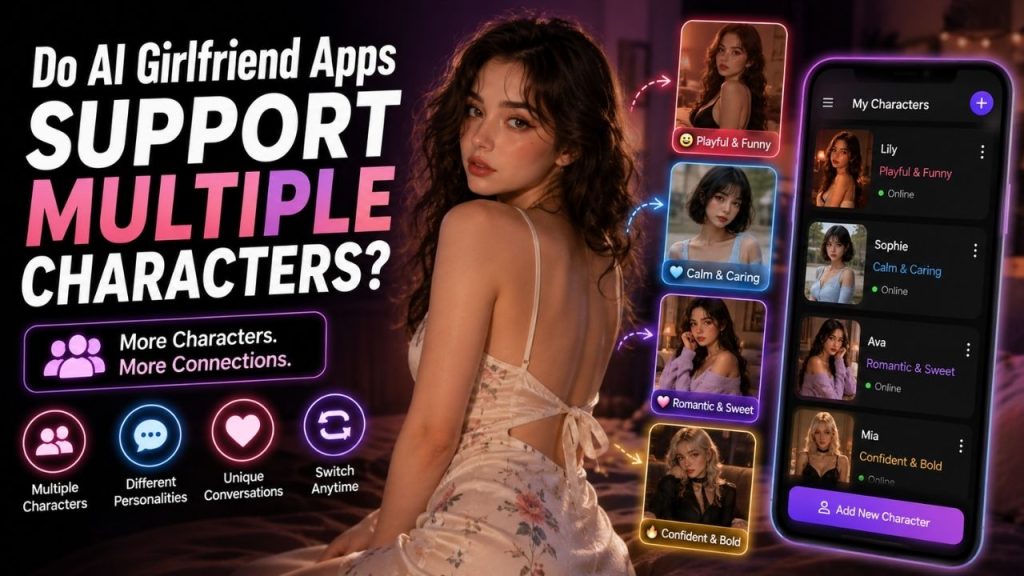
Having multiple AI characters means you can interact with more than one distinct AI persona within the same platform or account.
Instead of relying on a single character for every conversation, you can keep different companions with different personalities and communication styles.
For example, you might have:
| Character | Personality | Conversation Style |
| Emma | Playful and energetic | Casual and lighthearted |
| Sophia | Calm and thoughtful | Relaxed and reflective |
| Mia | Funny and confident | Expressive and humorous |
These are only examples, of course. The personalities you can access or create depend on the platform.
The important difference is that these characters can remain separate. You do not necessarily have to change Emma’s personality from playful to serious just because you want a different type of conversation. You may be able to keep Emma as she is and switch to Sophia when you want a calmer interaction.
Depending on the app, each character may also have its own name, appearance, personality settings, backstory, and conversation history.
However, there is no universal rule for how every AI girlfriend app manages multiple characters. Some platforms are designed around a single long term companion, while others are built specifically to let users explore or create many different AI personalities.
Different Ways Apps Handle Multiple Characters
Multiple character support usually falls into a few different models.
Multiple Custom Characters
Some platforms allow users to create several AI characters themselves.
Each character can potentially have a different identity. Depending on the available creation tools, you may be able to define details such as:
- Name
- Personality
- Backstory
- Interests
- Communication style
- Appearance
This approach gives you more control because you are not limited to the personalities already provided by the platform.
For example, you could create one character who is cheerful and talkative and another who is calm and more reflective. Both characters can remain available without requiring you to rebuild or rewrite the first one.
This model is especially useful for people who enjoy experimenting with different personalities but want to keep their favorite characters unchanged.
Libraries of Pre-Made Characters
Other platforms take a different approach. Instead of asking you to create every character, they provide a collection of existing AI personalities.
You browse through the available characters, choose one, and start a conversation.
This can be quicker because the character already has an established identity or personality.
The trade off is that you may have less control over individual details. A pre-made character may have a fixed name, appearance, background, or communication style.
Some platforms also allow a mixture of public, community created, and personally created characters. In those cases, users can explore existing personalities while still having the option to build their own.
A Combination of Both
Some AI companion platforms offer both pre-made characters and custom character creation.
This can be useful because the two options serve different purposes.
Pre-made characters are convenient when you want to start immediately. Custom characters are more useful when you already have a specific personality or concept in mind.
The important thing to remember is that access to many characters and the ability to create many personal characters are not necessarily the same feature.
An app might let you browse a large character library while placing limits on the number of characters you can personally create.
Moving Between Different Characters
If an app supports multiple characters, switching between them is usually similar to moving between separate conversations or profiles.
The exact interface differs, but the process may look something like this:
- Open the character, companion, or chat section.
- View the characters available in your account.
- Select the character you want to interact with.
- Continue an existing conversation or begin a new one.
- Return later and switch to another character.
The important point is that switching does not necessarily mean replacing one character with another.
Imagine that you spend the afternoon chatting with Emma. Later, you decide you want a different conversation style, so you open Sophia’s profile instead.
Emma can remain available. You are simply moving between different AI personas.
This is one of the biggest advantages of multiple-character support. You can maintain different experiences without constantly changing the same companion’s personality.
How Personalities Can Differ From One Character to Another
Multiple characters can give you access to very different conversation styles.
One character might be playful and energetic. Another may be calm and patient. A third might be more humorous, curious, confident, or reserved.
For example:
| Character | General Personality |
| Emma | Playful and energetic |
| Sophia | Calm and caring |
| Mia | Funny and confident |
With a custom character, the personality may be influenced by the information you provide during creation. Depending on the app, this could include a character description, backstory, traits, interests, instructions, or other settings.
Pre-made characters work differently. Their personalities may already be established by the platform or by the person who created them.
That means your level of control can vary.
A pre-made character may have a strong identity that is not meant to be heavily edited. A custom character may give you more freedom to define how you want the AI to communicate.
The practical benefit is simple. If you want different conversation styles, you may not need to keep changing the same AI girlfriend.
You can keep several personalities available and choose the one that fits the type of interaction you want.
Are Conversations Kept Separate?
In many apps, conversations with different characters are organized separately. However, the exact setup depends on the platform.
Separate chat histories can make it easier to maintain different conversations.
For example:
Emma’s chat: You have been talking about movies, music, and everyday events.
Sophia’s chat: Your conversations focus more on books, travel, and longer discussions.
When you return to Emma, you may continue that conversation rather than opening Sophia’s chat history.
This separation helps preserve the identity of each character and makes switching between personalities easier.
However, users should not assume that every app handles chats in exactly the same way.
Some platforms are built around a large number of separate characters and conversations. Others are designed primarily around one main AI companion.
So, if independent chat histories are important to you, check how the specific platform organizes characters and conversations before investing a lot of time in it.
How Memory Can Work Across Different Characters
Memory is one of the most important things to understand when using multiple AI characters.
The presence of several characters does not automatically mean that every character has a completely separate memory system.
Different platforms can store and use information in different ways.
Some information may be tied directly to a particular character or conversation. Other information may be connected to your overall account.
A general example looks like this:
| Type of Information | How It May Be Handled |
| Character personality | Usually connected to that character |
| Character appearance | Usually character-specific |
| Chat history | Often separated by character or chat |
| Long-term memories | May be separate or shared |
| General user preferences | May sometimes be account-level |
For instance, a character may remember something discussed during previous conversations with that character. Another character may begin without access to the same conversation context.
But this should not be treated as a universal rule.
Memory can be character-specific, conversation-specific, account-level, or based on a combination of these approaches.
If memory separation matters to you, it is worth checking the app’s current feature documentation and privacy information. Memory systems can also change as platforms update their products.
Multiple Characters vs. Changing One Character
These are two different ways of personalizing an AI companion.
Changing One Character
When you change one character, you keep the same AI girlfriend but modify some part of her identity or settings.
For example:
Emma: Playful → Calm
Emma remains the same character, but her personality may be adjusted.
This approach can work well when you only want to make a few changes.
Keeping Multiple Characters
With multiple characters, you do not have to replace one personality with another.
You can keep:
- Emma as playful
- Sophia as calm
- Mia as humorous
All three can remain available.
Here is the difference:
| Changing One Character | Keeping Multiple Characters |
| One main character | Several separate characters |
| Existing traits are adjusted | Each character can keep different traits |
| The original setup may change | Original characters can remain unchanged |
| Useful for smaller changes | Better for different experiences |
If you already like your existing character, creating another one can be more convenient than repeatedly changing her personality.
You can experiment without losing the version you already enjoy.
Managing Multiple Characters From One Account
On platforms that support the feature, one account may allow you to manage several characters.
Depending on the app, you may be able to:
- Create multiple characters
- Save individual character profiles
- Maintain separate conversations
- Switch between companions
- Edit individual characters
- Remove characters separately
However, the number of characters you can manage may depend on the platform and your plan.
There can also be a difference between characters you can access and characters you can create.
For example, an app may give you access to a large collection of existing characters but limit the number of personal characters you can save.
Another platform may focus more on custom companions and allow you to manage several characters that you created yourself.
That is why it is useful to check the actual character management features rather than assuming that “multiple characters” means unlimited companions.
Character Limits and Plan Restrictions
Some platforms place limits on character related features.
These limits can involve:
- The number of custom characters you can create
- The number of characters you can actively manage
- Access to advanced customization
- Free account restrictions
- Premium character slots
- Image or voice features connected to individual characters
The limits are not standardized across the industry.
An app may provide access to a large number of pre-made characters while limiting custom character creation. Another may allow several custom characters but restrict advanced features behind a paid plan.
This is why you should look at two separate questions:
How many characters can I interact with?
and
How many characters can I personally create and manage?
The answers may not be the same.
Pricing and plan limits can also change, so current details should always be checked directly within the platform before subscribing.
What Happens When You Remove a Character?
Removing one character does not necessarily affect the rest of your account.
However, what happens to the character’s information can vary from one platform to another.
Deleting a character may affect:
- The character profile
- Associated conversations
- Personality settings
- Appearance settings
- Saved information connected to that character
In some cases, removing the character may permanently delete associated data. In others, conversations and characters may be managed separately.
Before deleting a character that you have spent time developing, it is worth checking a few things:
- Can the character be restored later?
- Will the chat history also be deleted?
- Is there an archive option?
- Will removing the character affect other conversations?
This is particularly important when the character has a long conversation history or carefully customized settings.
When Multiple Characters Make Sense
Multiple characters are useful when you want different types of interactions without constantly rebuilding the same companion.
Different Conversation Moods
You might prefer one character for casual and humorous conversations and another for slower, more thoughtful discussions.
Instead of changing the personality settings every time your preference changes, you can switch between characters.
Different Interests or Conversation Styles
You may want different characters built around different interests or ways of communicating.
One could be designed around casual conversation, while another has a completely different personality or background.
Trying Something New Without Changing Your Existing Character
This is one of the most practical reasons to use multiple characters.
If you already enjoy your current companion, you may not want to risk changing her personality.
Creating another character allows you to experiment while leaving the original untouched.
Discovering What You Actually Prefer
Trying different personalities can also help you understand what type of AI interaction you enjoy.
You may initially think you want a highly energetic character but later discover that you prefer a calmer and more conversational personality.
Multiple characters give you the freedom to explore those differences.
What to Check Before Choosing an App
If multiple characters are important to you, do not simply look for an app that says it supports AI companions.
Check how the feature actually works.
How Many Characters Can You Create?
Find out whether there is a limit on personal characters.
A large public character library does not necessarily mean you can create unlimited companions.
Are Custom Characters Supported?
Some platforms focus almost entirely on pre-made characters.
If you want control over personality, appearance, or backstory, make sure custom character creation is available.
Are Conversations Separate?
Check whether each character has an independent chat or conversation history.
This can make a significant difference if you want to maintain several distinct relationships or storylines.
How Does Memory Work?
Find out whether memory is connected to:
- A specific character
- A particular conversation
- Your account
- A combination of these systems
Do not assume that every AI character knows exactly the same information about you.
Can You Edit Characters Later?
Your preferences may change over time.
Check whether you can update personality, appearance, or other character settings after creation.
What Happens When You Delete a Character?
Understand whether deleting a character also removes conversations and associated information.
If the character or chat is important to you, check whether an archive or recovery option exists.
Are There Free or Paid Limits?
Some platforms may limit custom characters or advanced features based on the plan.
Always check the current details before paying for access.
A Simple Example
Imagine you use an AI companion app that supports multiple characters.
You decide to keep three different companions.
Emma
- Playful
- Energetic
- Best suited to casual conversations
Sophia
- Calm
- Thoughtful
- Better for longer and more reflective discussions
Mia
- Funny
- Confident
- More expressive and talkative
Now imagine that you want a quiet, thoughtful conversation.
You do not need to change Emma’s personality from energetic to calm.
You simply switch to Sophia.
Later, when you want a lighter and more humorous conversation, you can return to Mia.
Emma remains unchanged throughout the process.
Depending on the platform, each character may also have separate chats, settings, and different forms of stored context.
That is the main value of multiple character support. It gives you flexibility without forcing you to constantly rebuild the same AI companion.
Conclusion
Many AI girlfriend and AI companion apps can support multiple characters, but the experience is far from identical across platforms.
Some are built around a large library of existing characters. Others focus on custom character creation. Some are designed primarily around a single long term AI companion.
The biggest advantage of multiple characters is flexibility.
You can keep different personalities available, experiment with new conversation styles, and avoid changing a character you already enjoy.
At the same time, there are important details to check. Character limits, memory behavior, chat organization, editing options, deletion policies, and free or paid restrictions can all vary.
If having multiple AI girlfriends or companions matters to you, look beyond the simple question of whether an app supports the feature.
Find out how many characters you can create, how easily you can switch between them, whether their chats remain separate, and how the platform handles memory.
Those details will tell you much more about what the multiple character experience is actually like.
FAQs
Can you have multiple AI girlfriends in one app?
Yes, some AI girlfriend and AI companion apps allow users to interact with or create multiple characters within the same account. The number of characters and available features depend on the specific platform.
Does each AI character have a different personality?
Yes, separate characters can have different personalities and communication styles. Pre-made characters may come with an established identity, while custom characters may allow users to define traits, interests, behavior, or other details.
Do multiple AI characters have separate chat histories?
Many platforms organize conversations separately for different characters. However, the exact way chat history is stored and managed depends on the app.
Do different AI characters share the same memory?
Not necessarily. Memory may be connected to a specific character, conversation, or account level system. Different platforms handle this in different ways, so multiple characters do not automatically mean completely separate memories.
Is it better to create multiple characters or change one character?
It depends on what you want. Changing one character can be useful for smaller adjustments. Creating multiple characters is usually more flexible when you want to keep several different personalities available without changing the original character.