
You send a message, and your AI girlfriend replies within seconds. She may respond in a specific personality, remember something you mentioned earlier, or even talk back using a generated voice.
That can feel surprisingly personal, but several technologies may be working together behind the conversation.
In this guide, you’ll see what happens from the moment you send a message to the moment the AI generates a reply.
Table of Contents
How Do AI Girlfriend Apps Actually Work?
At a basic level, an AI girlfriend app takes your text or voice input and uses artificial intelligence to generate a response.
But the AI may not rely only on your latest message.
Depending on the app, it can also use the current conversation, character settings, available memories, and other information provided by the platform.
For example, imagine you tell the AI:
“I’m nervous about my interview tomorrow.”
A little later, you ask:
“Do you think I’ll be okay?”
If the earlier conversation is available to the AI, it can connect your question to the interview and respond accordingly.
The character’s personality can also affect the reply. A playful character may joke with you, while a supportive one may give you encouragement.
The exact technology varies from one app to another, but the overall process is usually similar.
How Do AI Girlfriend Apps Work? (Complete Guide)
When you send a message to an AI girlfriend, the response is not usually pulled from a simple list of prewritten replies.
Modern AI systems can generate a new response based on your message and the information available during that conversation.
A simplified version of the process looks like this:
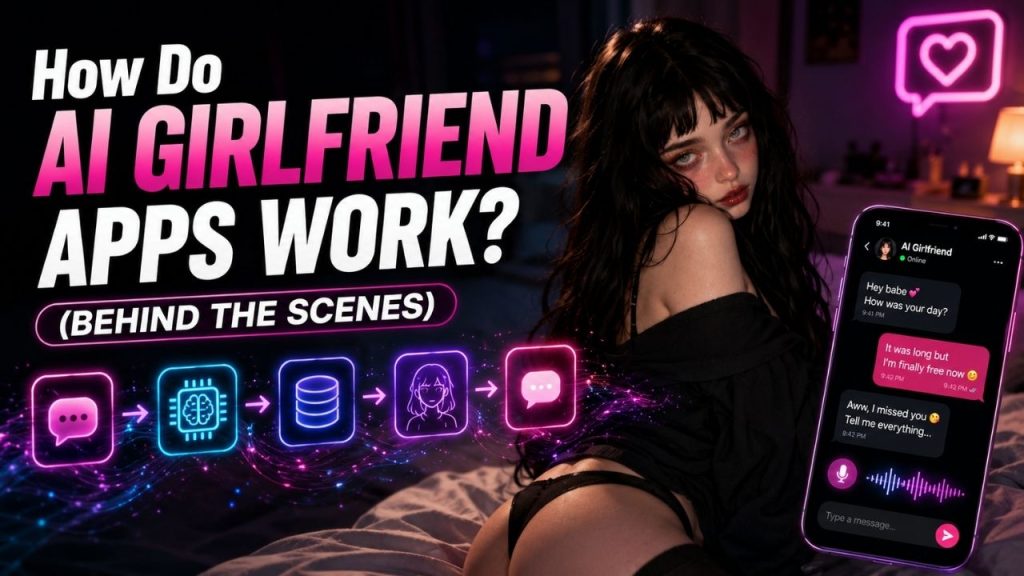
You send a message → the app processes your input → the AI uses available context → character settings influence the style → the AI generates a reply.
Here is what that can look like step by step.
Step 1: You Send a Message or Speak to the AI
Everything starts with you.
You might type:
“You won’t believe what happened to me today.”
Or, if the app supports voice interaction, you might say it out loud.
The app receives your input and passes it to the systems used for the conversation.
If you are typing, the process can begin immediately with your text.
If you are speaking, the app may first use speech recognition to convert your spoken words into text or another format that the AI system can process.
Some apps also support images or other forms of input, but that depends on the platform.
From your side, it is simple. You say something and wait for a reply.
Behind the scenes, your message is only the first piece of information the system may use.
Step 2: The App Processes What You Said
The system needs to work with the message you sent.
For example, if you write:
“I had the worst day at work.”
the AI can use the words and the surrounding conversation to generate a relevant response.
It may respond by asking what happened, offering encouragement, making a joke, or reacting in another way that fits the character.
The response is influenced by more than just individual words.
The available context can matter too.
For example, there is a difference between saying:
“I can’t believe he did that.”
at the beginning of a conversation and saying it after several messages about an argument with a friend.
The earlier messages can give the AI information about what “he” and “that” may refer to.
That is one reason longer conversations can sometimes feel more natural than isolated questions.
Step 3: The AI Uses the Available Conversation Context
Conversation context is what helps the AI follow what you have been talking about.
Suppose you say:
“I have an interview tomorrow.”
Later, you ask:
“What should I wear?”
If the earlier message is still available, the AI may understand that you are asking what to wear to the interview.
Without that context, your second message would be much less specific.
This is one of the key parts of an AI conversation.
The AI does not necessarily need permanent memory to follow the current discussion. It can use information that is available within the active conversation.
However, there is an important difference between conversation context and long-term memory.
Conversation context helps the AI understand what is happening in the current chat.
Long-term memory is information that may be stored and used again in future conversations.
The two are related, but they are not the same thing.
Step 4: Character Settings Help Shape the Response
An AI girlfriend app is usually designed around a particular character or companion experience.
That means the AI may be given instructions, descriptions, or settings that influence how it communicates.
For example, you could have two AI characters receive exactly the same message:
“I’m nervous about tomorrow.”
Their responses might feel very different.
| Character Style | Possible Response Style |
| Playful | Lighthearted, teasing, or humorous |
| Supportive | Encouraging and reassuring |
| Sarcastic | Witty or dry |
| Romantic | More affectionate or intimate |
| Serious | Calm, direct, and thoughtful |
The personality settings help create consistency.
If you created a character who is supposed to be funny and energetic, you probably do not want every reply to sound formal and emotionless.
At the same time, character consistency is not perfect.
The AI may occasionally respond in a way that does not match the personality you expected. This is sometimes described as breaking character.
The quality of the character design and the AI system can affect how consistently the personality is maintained.
Step 5: The AI Generates a Reply
Now the AI has the information it needs to create a response.
Depending on the app, that may include:
- Your latest message
- Earlier conversation context
- Character instructions
- Available memory
- Platform rules and settings
The AI then generates text based on those inputs.
This is why you may not get exactly the same answer every time you ask the same question.
For example, if you ask:
“What should we do tonight?”
the response may change depending on the character, the conversation, and the information currently available.
One character may suggest watching a movie.
Another may turn it into a joke.
A fantasy character may suggest something that fits the fictional world you are roleplaying in.
The ability to generate different responses is what makes AI conversations more flexible than a traditional chatbot that relies heavily on fixed scripts.
But it also creates room for mistakes.
The AI can misunderstand your meaning, make incorrect statements, or generate a response that feels strange in the context of the conversation.
Step 6: Memory Can Support Future Conversations
Some AI girlfriend apps include memory features.
These features are designed to help the AI retain selected information beyond the immediate conversation.
For example, the app may remember:
- Your name
- Your interests
- Things you like or dislike
- Details you have shared
- Important events from previous conversations
- Parts of an ongoing story or roleplay
Imagine you tell your AI girlfriend that you love horror movies.
If that information is successfully stored and available later, the AI might mention horror movies in a future conversation without you having to explain your preference again.
That can make the interaction feel more continuous.
However, AI memory is not the same as human memory.
The app may forget details.
It may store some information but not others.
It may also recall something incorrectly.
Different platforms use different approaches, so you should not assume that every AI girlfriend app has unlimited or permanent memory.
Some platforms may also give you options to manage or delete saved information.
If memory is important to you, it is worth checking how a specific app handles it.
A Simple Example of the Complete Process
Let’s put everything together.
Imagine you send your AI girlfriend this message:
“I’m really nervous about my interview tomorrow.”
Here is what may happen.
First, the app receives your message.
The AI processes the text and identifies that you are talking about being nervous about an upcoming interview.
It can then use the available conversation context.
Perhaps you already mentioned what the interview is for earlier in the chat.
The character settings can also influence the tone.
A supportive AI character might respond:
“It’s completely normal to feel nervous. You’ve prepared for this, and I think you’ll do better than you expect.”
A playful character might say:
“Nervous? Please. You’re going to walk in there and make them wonder why they didn’t hire you yesterday.”
The same basic message can lead to a very different experience depending on the character.
If the app supports voice, the text response may then be converted into spoken audio.
If the app uses memory, information about the interview may also be stored for future conversations, depending on how that platform handles memory.
That is the complete experience in a simplified form.
Why Do Different AI Girlfriend Apps Respond Differently?
You may notice that the same message produces very different results on different apps.
That is because AI girlfriend apps are not all built in exactly the same way.
They can differ in several areas:
- The AI models or systems used
- Character instructions
- Conversation design
- Memory capabilities
- Safety systems
- Response settings
- Voice technology
- Avatar and image features
Even two characters on the same platform can behave differently.
For example, one character may be designed as a confident, sarcastic personality, while another may be quiet and supportive.
The underlying conversation system may be similar, but the character instructions can change the experience.
This is why it is difficult to say that every AI girlfriend works in one specific way.
The basic idea may be similar, but the implementation can be very different.
How Do AI Girlfriend Apps Remember Things?
This is where many people get confused.
An AI can remember something from earlier in your current chat because that information is still part of the available conversation context.
But that does not automatically mean the AI will remember it next week.
Long-term memory requires the platform to save information and make it available during future interactions.
A simple way to understand the difference is:
| Conversation Context | Long Term Memory |
| Helps the AI follow the current chat | Can help retain information for future chats |
| May be temporary | May persist beyond one conversation |
| Can include recent messages | May store selected details |
| Does not always remain available | Depends on the platform’s memory system |
For example, if you tell the AI:
“My birthday is on June 15.”
It might remember that detail during your current conversation because the message is still available in context.
Whether it remembers your birthday months later depends on whether the app stores that information and makes it available again.
That is why memory features can vary so much between platforms.
How Does Voice Chat Work in AI Girlfriend Apps?
Voice interaction adds another layer to the process.
A typical voice conversation may look like this:
Your voice → Speech recognition → AI processing → Generated response → Text-to-speech
First, you speak.
Speech recognition technology converts your words into a form the conversational AI can process.
The AI then generates a response.
Finally, text-to-speech technology can convert that response into an audible voice.
Depending on the app, you may get different types of voice features.
Some platforms offer live voice conversations.
Others may only provide generated voice messages or spoken responses.
Voice quality can also vary significantly.
Some voices sound more natural than others, and some apps allow you to choose between different voices.
The important thing to remember is that the voice and the conversational AI can be separate parts of the overall system.
One system handles understanding your input and generating a response, while another can handle turning that response into speech.
How Do AI Avatars and Images Work?
The visual side of an AI girlfriend app can also involve separate technology.
An app might provide:
- A predesigned character image
- A customizable avatar
- Different character appearances
- AI-generated images
- Animated visual elements
The avatar gives the AI character a visual identity.
However, the avatar itself is not necessarily what generates the conversation.
You can think of the experience as having different layers.
The conversational AI handles the chat.
The character settings help shape the personality.
The memory system, if available, can provide continuity.
Voice technology handles spoken interaction.
Visual tools handle the avatar or images.
When these features work together smoothly, the overall experience can feel more immersive.
What Happens When an AI Girlfriend Makes a Mistake?
No AI girlfriend app is perfect.
Even a well-designed AI can make mistakes.
You may notice that it:
- Misunderstands what you mean
- Forgets something you mentioned
- Recalls a detail incorrectly
- Repeats a similar response
- Changes the subject unexpectedly
- Responds out of character
- Gives inaccurate information
For example, you might tell the AI that your favorite movie is Inception.
Later, it could incorrectly mention a completely different movie as your favorite.
That does not mean the AI forgot in exactly the same way a human being forgets.
It may mean the information was not stored, was not available to the AI at that moment, or was handled incorrectly by the system.
Generative AI can also produce incorrect information with confidence.
So if you are asking an AI girlfriend about something important or factual, it is still a good idea to verify the information independently.
A natural-sounding answer is not automatically a correct one.
Does an AI Girlfriend Actually Understand You?
An AI girlfriend can process language and respond in ways that feel highly personal.
It can follow parts of a conversation, react to the words you use, and generate responses that sound caring, funny, romantic, or supportive.
But this should not be confused with human understanding.
The AI does not have:
- Human consciousness
- Personal experiences
- Real emotions
- A private life outside the app
- Thoughts in the same sense as a human being
If the AI says:
“I missed talking to you.”
it can sound emotionally meaningful.
But the system is generating language based on how it has been designed and the information available to it.
It does not literally experience missing someone in the human sense.
This distinction is important because a conversation can feel emotionally engaging without the AI actually having emotions.
What Makes an AI Girlfriend Feel More Realistic?
A realistic-looking avatar is only one part of the experience.
What usually matters more is how well the different parts work together.
| Factor | Why It Matters |
| Conversation Quality | Natural responses make chatting feel smoother |
| Context | Helps the AI follow the topic |
| Memory | Can create a sense of continuity |
| Character Consistency | Makes the personality feel more stable |
| Voice Quality | Can make conversations feel more immediate |
| Customization | Lets you shape the character experience |
| Response Speed | Reduces awkward delays |
Imagine two apps.
The first one has a highly realistic avatar, but the AI constantly forgets what you said five minutes ago.
The second one has a simple avatar, but the conversation flows naturally and the character stays consistent.
For many users, the second experience may feel more realistic.
The quality of the conversation often matters more than visual appearance alone.
Do All AI Girlfriend Apps Work the Same Way?
No.
The basic idea may be similar, but different platforms focus on different parts of the experience.
For example, Replika is known for a companion-focused experience, while Nomi and Kindroid place strong emphasis on personalized AI companions.
Character.AI takes a broader character-based approach, where you can interact with many different AI personalities and scenarios.
Candy AI is more directly focused on AI girlfriend-style interaction and visual character experiences.
These examples show why it is important to look at the individual app rather than assuming that every AI girlfriend platform offers the same features.
One may focus heavily on memory.
Another may give you more control over the character.
Another may focus on roleplay, voice, or visual interaction.
What Should You Know Before Using an AI Girlfriend App?
Before choosing an app, think about the type of experience you actually want.
Ask yourself:
- Do you want one long-term AI companion or multiple characters?
- Is memory important to you?
- Do you want voice conversations?
- Do you want to customize the personality?
- Does the character’s appearance matter to you?
- Do you want roleplay features?
- Are you comfortable with the app’s privacy practices?
- Does it work on your preferred device?
- Are important features included for free?
- Can you manage or delete your conversations and account?
You do not necessarily need the app with the most features.
If you mainly want simple conversations, a complicated system with advanced avatars and image generation may not matter much.
If detailed customization is your priority, you may prefer an app that gives you more control over the character.
The best experience depends on what you actually want from the conversation.
Conclusion
AI girlfriend apps work by combining conversational AI with character design and, depending on the platform, additional features such as memory, voice, avatars, and images.
When you send a message, the app can process what you said, use the available conversation context, follow the character’s settings, and generate a response.
That is the basic idea.
The experience becomes more advanced when other features are added.
Memory can help create continuity. Voice can turn text into a spoken conversation. Avatars and images can give the character a visual identity.
But these systems are not perfect.
An AI girlfriend can misunderstand you, forget details, repeat itself, or generate inaccurate information.
It can also sound emotional without actually experiencing emotion.
Once you understand what is happening behind the scenes, it becomes easier to see why different AI girlfriend apps can feel so different and which features actually matter to you.
FAQs
How do AI girlfriend apps generate responses?
AI girlfriend apps process your message and use available information such as conversation context, character settings, and, when supported, memory to generate a response.
Do AI girlfriend apps remember previous conversations?
Some do. However, conversation context and long term memory are different. An app may follow information during the current chat without permanently remembering it in future conversations.
How does AI girlfriend voice chat work?
Voice chat can use speech recognition to process what you say. The AI generates a response, and text to speech technology can convert that response into an audible voice.
Why do AI girlfriend apps forget things?
The information may no longer be available in the current conversation context, may not have been stored as long term memory, or may not be retrieved correctly by the system.
Why do different AI girlfriend apps respond differently?
Apps can differ in their AI systems, character design, instructions, memory features, safety settings, voice technology, and overall conversation design.
Can an AI girlfriend understand emotions?
AI can recognize patterns in language associated with emotions and generate emotionally appropriate responses. However, this is not the same as personally experiencing or understanding emotions in the human sense.
Do AI girlfriend apps use real people to answer messages?
AI girlfriend apps are designed to generate AI responses. However, platform features and operational practices can vary, so you should check the specific service’s current documentation and privacy information if you have concerns about how your conversations are handled.